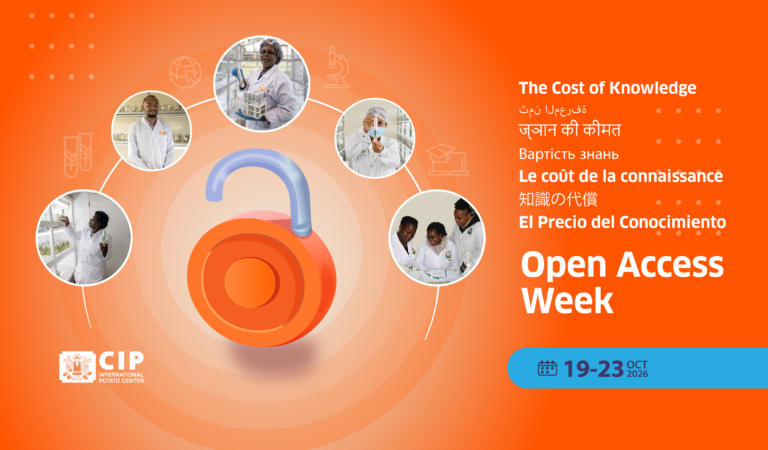
This week, the world celebrates International Open Access Week, an opportunity to ask a question that goes far beyond scientific publications: who can access the knowledge that society helps fund?
Imagine that research identifies a more sustainable way to produce food, a potato variety that is more resilient to climate change, or a tool that can help reduce food loss. The knowledge is available. But what happens if the people who could use it cannot access it?
Scientific knowledge costs money to produce, and much of that cost is paid with public funds. Its benefits should therefore reach everyone who needs them.
Publishing and accessing scientific research is part of a large-scale global industry. Some of the world’s leading scientific publishers have reported operating margins close to 40%. Making a single article open access in some journals can cost authors several thousand US dollars, and more than USD 10,000 at some high-profile titles. At the same time, a significant share of scientific research is funded through public or development cooperation resources, while researchers and peer reviewers generally contribute their work without payment from publishers.
The result can be a paradox: research is generated using resources intended to produce knowledge for society, yet that knowledge is not always available to society as a whole.
This is especially important in places where access to scientific information can make a difference. An agricultural technician looking for new ways to manage a crop, a student seeking to consult recent research, or an institution working directly with communities may encounter publications that require payment to access.
That is why open access matters.
Open access seeks to make scientific publications free for anyone to read and reuse, without the cost of a subscription or individual article becoming a barrier. And it does not always mean paying to publish. There are different mechanisms for sharing research legally and openly, including options such as sharing accepted manuscripts in institutional repositories, or publishing in journals that charge neither authors nor readers.
At the International Potato Center (CIP), our research is funded mainly by public and development partners, so the knowledge it generates is a global public good. , aligned with the CGIAR Open and FAIR Data Assets Policy, commits us to making our publications and data openly available. We do this through several routes: publishing open access, depositing accepted manuscripts, and sharing outputs through open platforms such as CGSpace and CIP Dataverse.
Behind every publication are years of research, collaboration, and resources. But research does not end when its findings reach a journal.
Knowledge has greater impact when it can be found, read, shared, and used.
For CIP, promoting open access means helping ensure that scientific evidence on crops, biodiversity, nutrition, climate change, and food systems can reach more people and organizations, especially in the countries and communities where this knowledge can help generate solutions.
Because science should not remain within the pages of a publication.
When knowledge circulates, its capacity to generate impact grows too.