Instructions for Exportation of In Vitro Materials from Peru
These instructions apply exclusively to the exportation of
in vitro potato and sweetpotato materials from Peru.
Order limitation:
The maximum number of accessions that can be requested is
35 accessions of MLS=1 or MLS=99 per year. Orders exceeding this limit will be
delayed, and you will be contacted to justify your request.
1. Requirements for the Export Procedure
1.1 Phytosanitary Requirements
NPPO Import Permit
The import permit must specify the requirements for importing
in vitro material. Please scan the document and send it in advance
by email as a PDF file to:
CIP-germplasm@cgiar.org
Information Required on the Import Permit
| Institution |
CENTRO INTERNACIONAL DE LA PAPA |
| Address |
AV. LA MOLINA NRO. 1895 ESTACION EXPERIMENTAL
(FRENTE A LA UNALM) LIMA, 15024, Perú
|
| Attention |
Dr. Maarten van Zonneveld
Maarten.VanZonneveld@cgiar.org
|
| Telephone |
+51 1 349-6017 |
| Crop name |
Potato or Sweetpotato |
| Scientific name |
Solanum tuberosum or
Ipomoea batatas
|
| Form |
In vitro plants |
| Quantity |
Total number of glass tubes and total number of
in vitro plants
|
Important:
Each tube contains 2 potato plants or
1 sweetpotato plant.
Review of Phytosanitary Requirements
Upon receipt of the Import Permit, CIP reviews the requirements
established by the importing country's NPPO, particularly the
quarantine pests that must be tested. CIP will also request our
NPPO (SENASA) to register the requirements in its system.
CIP's in vitro potato and sweetpotato plants routinely test negative
for quarantine pathogens and are verified as pathogen-free, including
viruses and, in potato, viroids and phytoplasmas, as well as bacteria
and fungi, through host range testing and a combination of indexing
methods.
For further details, please contact
CIP-germplasm@cgiar.org
.
Additional testing:
If the Import Permit requires additional testing for viruses not
included in our routine screening, the materials must be propagated
and submitted to the CIP Germplasm Health Unit (CIP-GHU) for analysis.
The cost of these additional tests must be covered by the requester.
The propagation process takes approximately 20 days,
while testing and result assessment take around
30 days.
Once this process is completed and all additional requirements are met,
final propagation can proceed prior to shipment.
Peruvian Phytosanitary Certificate
After inspection of the materials by our quarantine authority,
SENASA, CIP will send the phytosanitary certificate
via email for your review and for processing the importation of
the product.
Packaging
The product to be shipped will be contained in new, first-use
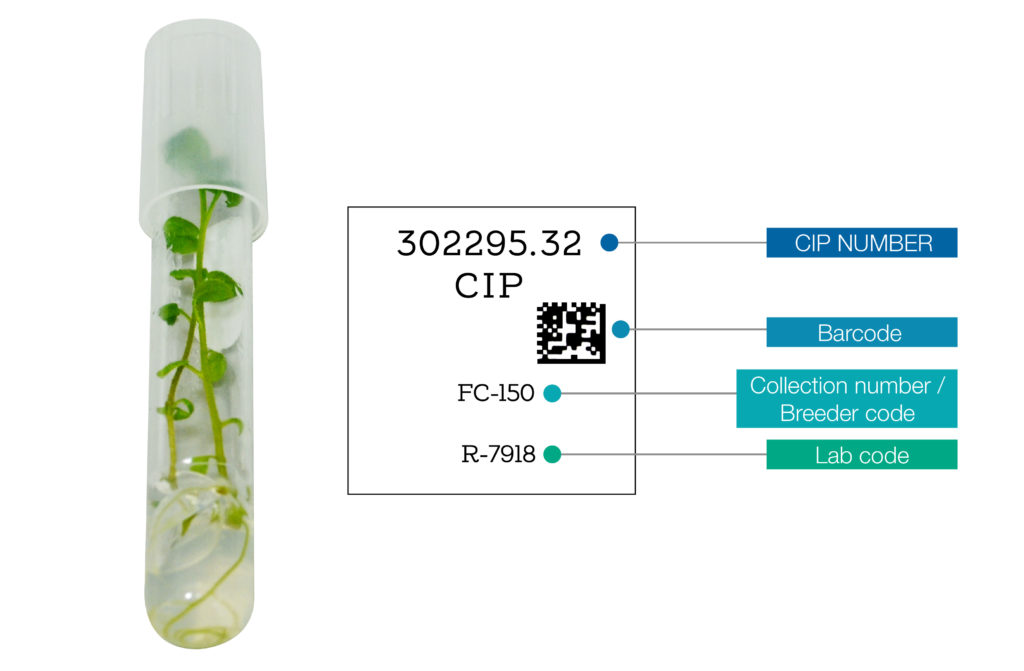
packaging (cardboard box). The glass tubes containing the in vitro
plants will be labeled and well packed to avoid breakage during transit.
Phytosanitary Inspection at Entry Point
Depending on your NPPO requirements, a phytosanitary inspection may
be required at the point of entry into your country.
1.2 Customs Clearance Requirements
CIP will be responsible for preparing the following documentation
and sending it by email in advance for review:
- Commercial invoice
- Packing list
- List of materials
-
Export declaration — only for countries where the quarantine
authority does not issue an import permit, or in cases where
it is required
-
Additional documents requested by your quarantine authority
(certificate of origin, non-GMO certificate, etc.)
1.3 Coordination with the Plant Transport Service
CIP will coordinate the shipping service depending on the requirements
of the NPPO in your country. The service may be provided by courier
or air cargo.
Climate conditions during transit will also be considered to ensure
proper care of the plants. External conditions may otherwise cause
physiological damage to the material.
Potato
Potato plants are sensitive to high temperatures.
Sweetpotato
Sweetpotato plants are sensitive to low temperatures.
DHL Service
Delivery via courier, without temperature control.
World Courier Service
Delivery via air cargo or courier service, with temperature
monitoring within the 15–25 °C range.
Shipment Tracking Documentation
CIP will send the following documentation by email for tracking
purposes. For this, it is required to provide the complete
Consignee name when filling out the request
submission form.
-
Airwaybill (AWB) — includes the tracking number.
2. Procedure
When the germplasm is distributed, the following official documents
are required:
1. Import Permit
Import Permit sent by the requester.
2. Approved SMTA
Standard Material Transfer Agreement (SMTA) approved and signed.
3. SENASA Certificate
SENASA Phytosanitary Certificate.
2.1 Before Sending
1
Preparation of Documentation
Preparation of documentation depends on how long it takes
to define the list of materials.
-
CIP will verify the availability of the requested materials.
-
CIP will submit the request through the FAO web system
for acceptance/signature of the SMTA.
-
If the material is MLS=99 (under development), an
additional terms agreement must be signed.
-
The import permit must be processed according to the
requirements of the importing country.
2
Propagation of Materials
Propagation depends on the quantity of material requested.
The standard propagation is approximately
2 tubes per accession in 6–10 weeks.
Propagation begins once all documentation is complete,
including the Import Permit and accepted SMTA, the
requirements have been registered in the SENASA system,
and the materials are available in the laboratory.
3
Inspection by SENASA
The inspection process takes approximately
7 business days to schedule the inspection,
pay the inspection fees, carry out the inspection, and
issue the certificate.
2.2 Preparing the Shipment
Documents
Copies and originals of the documents accompanying the shipment
will be prepared as follows:
-
Original documents:
placed in an envelope attached to the box.
-
Copy:
placed inside the box.
-
Copy:
sent together with the airway bill of the courier and the
simple guide.
Shipping Service
- Shipment via DHL or World Courier.
-
New primary packaging, with the material sealed in glass tubes.
Packaging Examples
New Primary Packaging, sealed in glass tubes.
New primary packaging, the seeds will be placed inside
the aluminum envelopes.
Packaging for Shipment
Packaging for shipment via DHL or World Courier
without temperature control.
Packaging for shipment via DHL or World Courier
with temperature control.