
 On October 15, the International Day of Rural Women, which coincides with the International Year of the Woman Farmer 2026, the International Potato Center (CIP) reaffirms its commitment to supporting rural women through research that expands their leadership in building more resilient and sustainable agrifood systems.
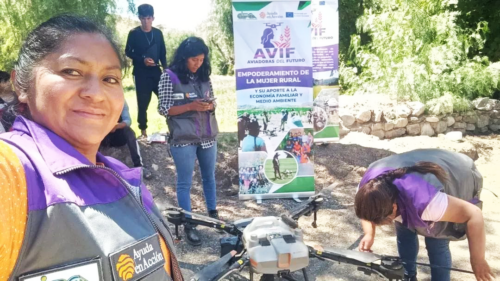
This research builds on a project in Bolivia called “Aviadoras del Futuro (AVIF)” which trains women as agricultural drone pilots to provide crop spraying services. Women’s participation as specialized agricultural drone operators challenges traditional gender roles in digital technology spaces, transforming Indigenous women into pioneers of digital agriculture in their communities.
Drone use also has positive impacts on agriculture, including more precise application of pest and disease control products, reduced water use, and lower production costs. Furthermore, it can reduce the use of agrochemicals by enabling the application of organic biopesticides and biofertilizers instead of conventional chemicals, improving crop quality and strengthening the local economy.
Building on this model of training and entrepreneurship, CIP and the PROINPA Foundation seek to scale up this intervention through research to address two key challenges in the Andean region: (1) persistent gender gaps in digital agriculture, and (2) emerging phytosanitary threats that require improved surveillance and early warning systems, such as the Purple Top Complex.
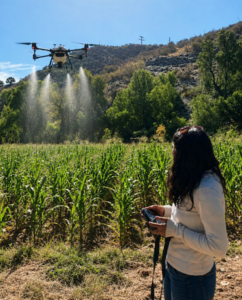 The central question is: How can women-led drone enterprises evolve from providing crop spraying services to offering digital phytosanitary intelligence services, including crop monitoring, pest and disease diagnosis, and risk mapping?
The research seeks to identify the barriers that limit rural women’s participation in digital spaces. In doing so, the project will expand opportunities for women to engage as entrepreneurs in the monitoring and management of phytosanitary threats, strengthening their financial independence and leadership.
Through this research, CIP aims to foster a more inclusive, resilient, and sustainable agrifood system by positioning Indigenous women as key protagonists in the digital transformation of agriculture. The drones in this case are an example of how digital technology can be a tool for transformation rather than a source of inequality.