On August 19 and 20, nearly twenty colleagues from CIP – Peru, CIMMYT – Mexico, and Alliance Bioversity & CIAT – Colombia gathered at the International Potato Center in Lima to answer a question that seems simple but changes everything: why and how to scale?

In a world shaped by climate crisis, food insecurity, and inequality, having successful pilots is not enough: we need innovations to reach further, in a fair, inclusive, and sustainable way. We wanted to create a space to share real experiences, learn from each other about challenges and successes in our scaling journeys, and strengthen our collective capacities on the subject.
This is the story of the Capacity Building Workshop for Scaling Innovations, held thanks to the generous support of CIP’s Human Resources Department and CGIAR’s Scaling for Impact Program (S4I).
DAY 1: CONCEPTS TURNED INTO PRACTICE
 The day began with a journey to the origins of scaling at CGIAR, led by Deissy Martínez-Barón (Alliance Bioversity & CIAT – Colombia), who explained how the S4I Program was born to move beyond the linear vision of “spreading technologies” and embrace a systemic approach. Deissy put it clearly: “Scaling is not just about disseminating technology. It is about ensuring solutions reach people and improve lives.”
Next, Katharina Schiller (CIMMYT – Mexico) invited us to see things differently, questioning traditional models, and thinking of scaling as part of broader transitions toward sustainability in agri-food systems. Guided by her, we applied the Scaling Scan, an accessible and simple tool that helped us quickly analyze innovations in their contexts, identify bottlenecks, and define next steps to close gaps.
In the afternoon, Willy Pradel (CIP) and Andrea Castellanos (Alliance Bioversity & CIAT) showed us how to measure innovation maturity and use with the Scaling Readiness and Scaling Use approach. The theory came alive through the readiness calculator tool, and again when Gabriela Burgos and Jorge Andrade-Piedra (CIP) shared the case of Biofortified Potatoes, an innovation fighting anemia through something as simple as a meal on a plate.
DAY 2: STORIES THAT INSPIRE
The morning was all about action: we built scaling roadmaps in teams, debating how to take our innovations beyond the pilot stage. Then, Carolina Rodríguez (CIP-Lima) explained how CGIAR evolved from talking about “scaling” to promoting a responsible and inclusive scaling approach, one capable of anticipating social and environmental risks. Trent Blare (CIP-Ecuador) shared an experience in responsible based on a model of including Indigenous women in agroecological value chains in Ecuador.
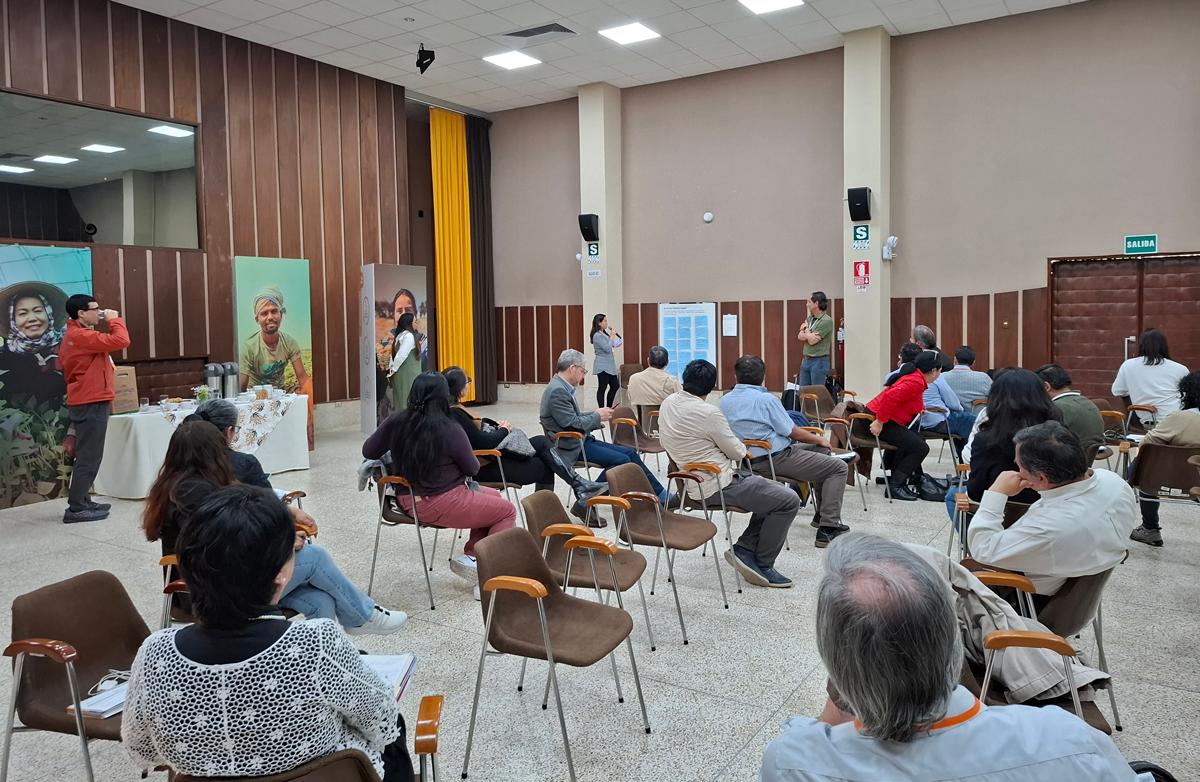
The afternoon brought diverse voices in the session “Regional Articulation for Scaling – Latin America in Focus”:
- From FAO, Miriam Céspedes presented the Farmer Field Schools, where collective learning transforms agriculture.
- From GIZ, Alejandra Muñoz shared the Resilient Puna Project, which integrates ancestral knowledge, multilevel governance, and innovative financing to face climate change in the Andes. Valeria Biffi explained how they have integrated the Gender Approach into the NDCs to overcome challenges and seize opportunities in the agricultural sector.
- WHH, through Lucas Dourojeanni, shared how their Multi-Actor Platforms achieve policy changes and strengthen food security through agroecology in Peru and Bolivia.
- The Alliance Bioversity & CIAT, through Andrea Castellanos demonstrated how Agroclimatic Technical Tables transform climate data into useful decisions for rural communities in 11 countries in the LA region.
- From CIMMYT, Katharina Schiller inspired us with their Innovation Hubs, co-creation spaces where farmers, scientists, and companies build and scale sustainable solutions.
- And from CIP, the Biofortified Potatoes returned with Gabriela Burgos, reminding us that an innovation can be as powerful as an iron-rich tuber that helps combat anemia among women and children.
The World Café Session kept us moving between topics, listening and contributing until our learnings wove together into a collective understanding of and for scaling for the region.
WHAT WE LEARNED TOGETHER
The phrases left on the auditorium walls were as powerful as they were simple:
- “Pilots never fail, pilots never scale.” Many pilots don’t transcend.
- “We don’t scale products, we scale packages and enabling conditions.” Technologies, actors, and institutions must work together.
- “Trust is as important as technology”: Innovations in the Andean Region have a strong social and institutional dimension, requiring us to adapt traditional scaling approaches.
Our shared learnings were:
- Solid partnerships, shared leadership, and sustainable financing are essential conditions to move forward.
- Scaling must anticipate and offset social, economic, and environmental impacts. To do this, classic indicators must be complemented with metrics on equity, inclusion, environmental sustainability, and fair distribution of benefits.
- The inclusion of gender and youth in scaling is central.
- Scaling is not just about growing numbers: it is about learning together, building trust, and strengthening local capacities.
And the warning: “Scaling without awareness can generate inequality, harm, and loss of trust.”
BEYOND THE WORKSHOP
By the end of two days, we left with initial roadmaps, a shared language, and, above all, a conviction: Latin America cannot scale using recipes imported from the Global North. We need our own approaches, flexible and “tropicalized,” capable of recognizing our socio-institutional innovations and the richness of our contexts.
Responsible scaling is, in fact, a collective commitment. A commitment to gender equity, to youth, to environmental sustainability, and to the communities that make change possible.
AN OPEN INVITATION
This workshop was only a beginning. We must now continue co-creating, learning from failures and successes, and building diverse alliances. One upcoming opportunity is the “Scaling Week in Latin America” (Sept 29 – Oct 3, 2025), organized by Alliance Bioversity & CIAT and CGIAR’s Scaling for Impact Program (S4I), which will offer virtual sessions to strengthen capacities in responsible agricultural innovation scaling with a focus on sustainability, inclusion, and climate adaptation.
The invitation is open: let’s join efforts so that our innovations can transform the region’s agri-food systems, leaving no one behind.