On this World Children’s Day, the International Potato Center (CIP) spotlights our engagement with youth throughout Latin America. Although the projects vary in socioecological environment and approaches, they share a common goal: involving youth in agrobiodiversity conservation, intergenerational knowledge exchange, and identity expression.
Scroll through this article to discover how CIP works alongside youth to advance agrobiodiversity conservation and research.
Birdwatching in the páramos of Cumbal, Colombia
Working with a network of more than five partner schools and over 400 families in Cumbal – Colombia, CIP set out to answer a fundamental question: Do agricultural practices promoted as an institution, such as reduced pesticide use, truly generate a positive impact on biodiversity?
To respond to this question, CIP teamed up with some unlikely research assistants: kids.
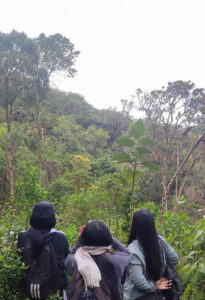
Through the Multifunctional Science Program (MFL), CIP drew on a generations-long tradition in the province of Cumbal, Colombia, birdwatching, as a biodiversity-monitoring practice. Together with elders, teachers, and scientists, kids experience and learn about birdlife as an important indicator of ecosystem health and the role of mindful agricultural practices in sustaining it.
For example, kids learn that birds are less likely to inhabit areas where toxic pesticides are applied, showing them how this practice harms the environment. Through this lesson, they connect their interest in birds and birdwatching with the importance of environmental conservation.
This project links scientific outcomes (improved biodiversity) with local social realities and ancestral practices – birdwatching. This creates an opportunity to evaluate the effectiveness of agricultural practices while raising awareness about the importance of preserving natural habitats.
Citizen science contests for agrobiodiversity
Native potatoes are not stored in a gene bank alone. They live in farmers’ fields, where families have conserved native varieties for generations. Keeping track of this in situ diversity requires regular, field-level observation. That is more than any research team can do on its own. So, CIP is turning to the youth for help.
CIP’s citizen science contests bring together students, teachers, and communities to document crop varieties, wild species, and the knowledge associated with them.
- Guardians of Native Potatoes: This national contest invites participants to record native potato varieties y entering photos, local names, associated knowledge, and locations into AgroBioID. In doing so, participants help document and preserve valuable information about native potato diversity. A cultural valorization category on the website also invites students to document the knowledge, traditions, and expressions linked to native potatoes. From 2024 to 2026, it engaged 1,553 children across 21 regions of Peru, while participants generated 4,114 georeferenced observations in 2024 and 2025. All records can be explored on the WikiPapa
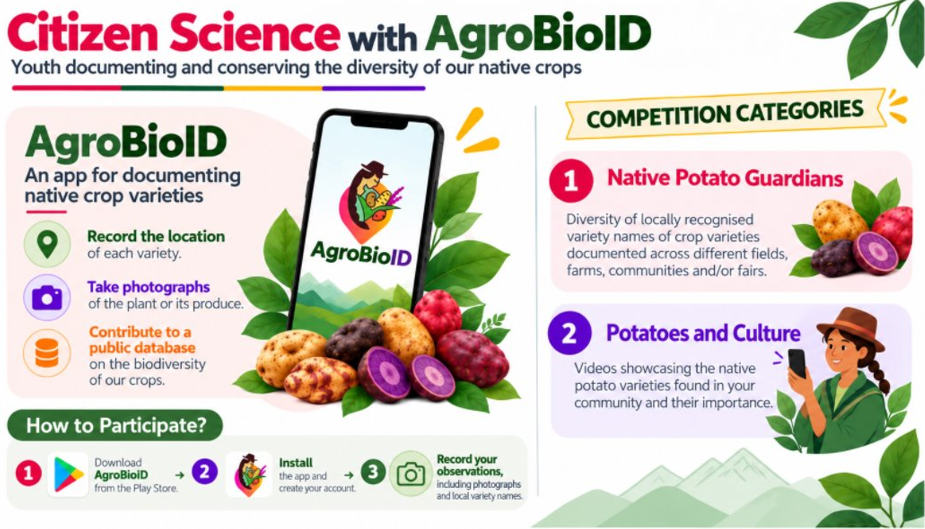 Guardians of Amazonian Agrobiodiversity: In 2026, students in the communities of Nolbert, Nuevo Paraíso, Limongema, and Sinchi Rocan in the Ucayali region used AgroBioID to document seven Amazonian roots and tubers grown by local farmers: cassava, sweet potato, sachapapa, pituca, ashipa, dale-dale, and aerial potato. Participants were awarded according to the number of locations, local names, and varieties documented as well as for submitting complete records with clear and creative photos. Through these contests, children learn the names and stories behind local varieties and begin to see themselves as guardians of their community’s diversity, just like their parents and grandparents.
- Guardians of Amazonian Agrobiodiversity: While the other two contests focus on crops grown by local farmers, this initiative invites residents of the Yamino community, secondary school students from Padre Abad, Shambo, and Shambillo, students from the National University of Ucayali, to use iNaturalist to record wild flora and fauna in Ucayali, including plants, fungi, birds, amphibians, and mammals. Participants receive free training and join two guided field trips with a specialist to document images. These observations help build a clearer picture of the region’s biodiversity and how it changes over time.
These contests help expand the recording of native varieties and support broader efforts to monitor agrobiodiversity. By connecting schools, farmers, and communities, they encourage young people to participate and help pass local knowledge on to new generations.
Photovoice and Field to Film: Youth-led storytelling in Ecuador and Peru
In Ecuador’s and Peru highlands, climate change is no longer a distant concern. It is something people are dealing with every day. Climate change manifests in various ways including prolonged and severe droughts, seasonal dry spells in the rainy season, intense rains in the dry season, hail, and frost.
These environmental pressures are unfolding alongside ongoing rural–urban migration. Many young people move back and forth between rural communities and nearby cities in search of better access to education and a stable income while still maintaining ties to their farming livelihoods.
The project Andean Crops Diversity for Climate Change uses a participatory approach called Photovoice to document how climate change is affecting agrobiodiversity, particularly potatoes and mashua, in the Andes. In collaboration with partners Fundacion Ekorural, Yanapai Group, Universidad Nacional del Centro del Perú (UNCP)and JORA: the Photovoice project unfolded through five field visits in Quilcas, Peru that brought together 19 young people, experienced photographers, scientists, and community members alike.
Participants are given cameras and decide what they want to photograph, capturing the changes they observe in their surroundings and explaining why these matter to them. For example, a participant might photograph the effects of frost on crops and accompany the image with their own reflections on what they observed, how they understand its impact, and how local farmers respond to these conditions. Together, the photograph and narration capture young people’s perspectives on climate change while documenting valuable local knowledge and adaptation practices.
During the field visits, an unexpected positive outcome emerged as the project became a space for reconnecting with personal experiences with agriculture, which the university students had not previously viewed as something that could be studied from an anthropological and scientific perspective. This type of discovery is particularly meaningful in the context of rapid urbanization as fewer young people remain in rural areas each year to value and pass on these generational agricultural legacies.
The photographs and narratives were returned to the communities in an event involving more than 180 people where students explained the effects of climate change and the adaptation practices they documented to community members, local authorities, and institutions. The photos will also be presented in an exhibition at the university and will also contribute to a photobook that facilitates international knowledge exchange.
As a part of the same “Andean Crops Diversity for Climate Change” initiative, youth in Ecuador participated in the “Field to the Film” festival organized by Groundswell International. They created a short documentary titled “Kawsay Papa, the potato that gives life” exploring the impacts of climate change and potato agrobiodiversity loss through an intergenerational lens.
The participants took ownership of the documentary as the idea, storyline, and production were entirely led by the participants themselves and group has stayed together since, engaging in further self-driven projects.
The documentary can be accessed here.
Through narrative storytelling projects like these, young people are not only affected by climate change but actively shape how it is experienced and imagined.
Weaving together words, territory, and memory: community communication in Cumbal, Colombia
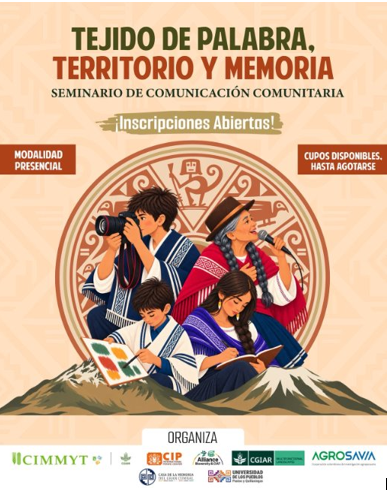 This project engages local radio stations to train young people in radio production and podcasting. Participants learn how to develop and run their own radio program, writing scripts and producing podcasts about agriculturalists who are custodians of potato biodiversity and the people who protect local water sources and páramo ecosystems. Through this pilot project, CIP scientists seek to understand how community communication practices such as podcasting can help evaluate the impact of agroecological practices in Cumbal.
In collaboration with La Casa de la Memoria and the youth group of Cumbal, the team also aims to strengthen connections between scientists, community elders, and youth. In doing so, the initiative aims to weave a rich fabric of territorial knowledge and collective memory, passing on ancestral knowledge and respect for the land to younger generations through creative communication technologies.
School visit at CIP headquarters in Lima
Held in celebration of World Children’s Day on November 20, CIP organized a visit with a local secondary school to introduce students taking Biology, Chemistry, Physics, and ESS (Environmental Systems and Society) courses to CIP’s work – offering these future scientific leaders an opportunity to see what scientific research looks like in practice.
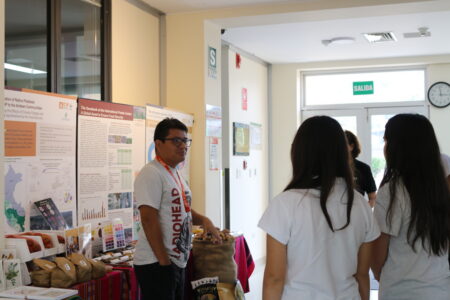
The students visited CIP’s campus in Lima, where they learned about several research projects, including the genebank and cryovault. They then toured the genebank, including the DNA laboratory, CryoLab, and herbarium. By engaging young people in CIP’s work, these collaborations aim to inspire the next generation of scientists and researchers.
World Children’s Day is UNICEF’s Global Day of Action for children, by children
Across Latin America, young people are not simply learning about agrobiodiversity conservation. They are actively contributing to it. In Quilcas, Ecuador, they document ancestral agricultural knowledge through Photovoice. In Cumbal, Colombia, they learn to recognize healthy, pesticide-free environments by observing bird diversity. At CIP headquarters in Lima, Peru, students interested in ecology and natural sciences experience scientific research firsthand.
By creating opportunities for young people to observe, document, and investigate the world around them, CIP is helping prepare the next generation to carry this work forward.
The Guardians of Native Potatoes contest is funded by the Benefit-sharing Fund (BSF5) of the International Treaty on Plant Genetic Resources for Food and Agriculture (ITPGRFA), under agreement LoA/TF/PR-27-M-Peru/2023/OCBDT, and by the CGIAR Science Program on Multifunctional Landscapes (MFL). It is supported by Iniciativa Andina, CONCYTEC, IFAD, Grupo Yanapai, Stats4SD, INIA, IDMA, Peru’s Ministry of the Environment, FAO, Asociación Pataz, and Poderosa. The Amazonian contests in Ucayali are funded by the CGIAR Science Program on Multifunctional Landscapes (MFL), AIDER, and AGROSALUD.