
BEIJING, China — Dr. Simon Heck, Director General of the International Potato Center (CIP), attended the opening ceremony and a roundtable of the World Agrifood Scientists Forum at the 2026 World Agrifood Innovation Conference (WAFI 2026), held in Pinggu District, Beijing, from 17 to 19 September, and delivered a keynote address at the Forum on Tropical Agriculture and South-South Cooperation on 19 September.
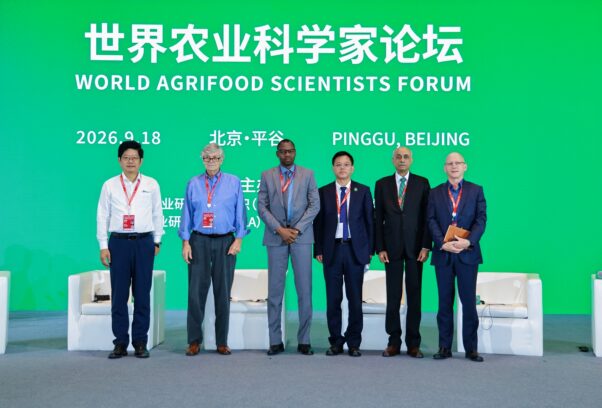
At the roundtable, Dr. Heck shared CIP’s experience of taking sweetpotato science “from research to scaled impact” and stressed that agricultural innovation must be co-created and locally led, so that scientific advances take root in each country’s farming realities and reach meaningful scale. He also called for deeper South-South cooperation in tropical agriculture.
In his keynote, Dr. Heck noted that the potato is rapidly expanding from a temperate crop into a tropical one, with Asia now the world’s largest potato-producing region. He presented two CIP breakthroughs of global significance, offering the Asia-Pacific region its first systematic overview of these innovations.
The first breakthrough — biotech late blight resistance — introduces three resistance genes from wild potato relatives (Rpi-blb1 and Rpi-blb2 from Solanum bulbocastanum, and Rpi-vnt1.1 from Solanum venturii) into farmer-preferred varieties such as Victoria, Asante, Shangi, Tigoni, Desiree, Jalene and Unica. Regulatory milestones are following across Africa: Rwanda granted full approval of the triple-stack biotech events in September 2025, with registration of the Sha.105 and Vic.185 varieties expected in October 2026; Kenya approved its first event in October 2025, with confined field trials underway; and Nigeria submitted regulatory dossiers for five events in June 2026.
The second breakthrough — diploid hybrid potato breeding — combines CIP and HZPC genetics through a public-private partnership to breed new hybrid varieties that deliver high yields, climate resilience, disease resistance and the quality traits markets demand — a step change in genetic gains, adoption speed and trait integration.
These innovations are already moving from laboratory to field. In Kenya, CIP and the Dutch seed company HZPC are jointly breeding new hybrid varieties, with CIP’s breeding hub in Nairobi — run jointly with the Kenya Agricultural and Livestock Research Organization (KALRO) and the Kenya Plant Health Inspectorate Service (KEPHIS) — accelerating their delivery to farmers. In China, CIP and the Agricultural Genomics Institute at Shenzhen, Chinese Academy of Agricultural Sciences (AGIS), have established a joint laboratory to speed the translation of fundamental science into hybrid potato breeding, forming a complementary global footprint.
Looking ahead, the CIP South Asia Regional Center (CSARC) is now operational, convening research institutions and seed-sector partners across South Asia to bring key innovations such as late blight biotechnology into regional adoption pipelines. At the World Potato Congress in Kenya at the end of October 2026, CIP will launch AfricaBlight, a cross-border network building a coordinated regional defense against late blight — one of agriculture’s most devastating diseases.
“Biotechnology and hybrid breeding are not about incremental improvement — they are about transforming the foundations of an entire industry,” said Dr. Heck. “CIP looks forward to working with China and partners across the Global South to turn these breakthroughs into global public goods, delivered through South-South cooperation to the smallholder farmers who need them most.”
Held under the theme “Green and Healthy Transformation of Agri-Food Systems,” WAFI 2026 brought together nearly 300 international guests from more than 30 international organizations, research institutions and business associations, along with numerous representatives of Chinese universities, research institutes and industry. The conference was co-hosted by China Agricultural University, the Beijing Municipal Bureau of Agriculture and Rural Affairs, the People’s Government of Pinggu District and CGIAR. Since its launch in 2023, WAFI has grown into a key global platform for innovation and collaboration in agri-food systems.