5 November 2026, Lima, Peru – In a major milestone for global crop diversity conservation, Brazil, Chile and Ecuador will jointly deposit safety copies of their crop diversity in The Plant Cryo Vault at the International Potato Center (CIP) in Lima, Peru. The event marks the first coordinated effort by multiple countries to safeguard vegetatively propagated crop diversity in an international vault using cryopreservation as a cost-effective innovation to safeguard crop diversity.
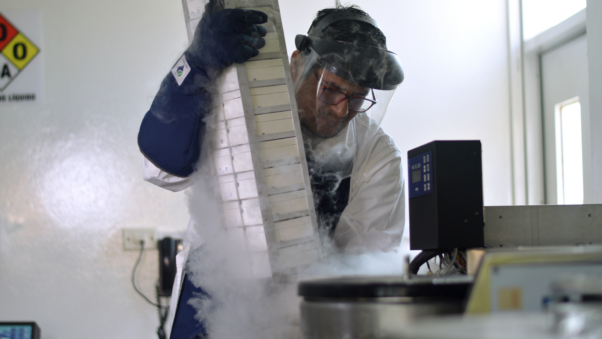
Crop diversity is essential for feeding the world in a changing climate, yet it is increasingly threatened by land-use change and the homogenization of diets. Nearly half of the 150 crops tracked by the United Nations—including potato, cassava, sweetpotato, banana and many tree crops—require conservation approaches beyond conventional seed storage. The Plant Cryo Vault is a state-of-the art facility at the foothills of the Andes that provides a secure, long-term safety backup for these crops by preserving tiny plant shoot tips or embryonic axes in liquid nitrogen at minus 196 °C.
“The Plant Cryo Vault complements the Svalbard Global Seed Vault by providing an innovative technology to safeguard crops that cannot be adequately conserved through conventional seed storage, bringing us closer to a truly global safety net for crop diversity,” said Maarten van Zonneveld, Head of the Genebank at CIP.
Dr. Silvia Massruhá, President of the Brazilian Agricultural Research Corporation (Embrapa); Mr. Kent Nnadozie, Executive Secretary of the FAO Plant Treaty, and Mr. Fuad Gasi, Coordinator of the Svalbard Global Seed Vault, will deliver keynote addresses to mark this important milestone in crop diversity conservation.
For Embrapa and Chile’s Agricultural Research Center (INIA), these will be their first deposits in The Plant Cryo Vault. Embrapa will deposit 14 traditional pineapple varieties and 11 cassava varieties from the Amazon region. INIA will safeguard 10 potato accessions from Chile, a secondary center of potato diversity. Ecuador’s Agricultural Research Center (INIAP) will make its second deposit, contributing 30 groundnut and three potato accessions.
The deposited material remains under the ownership of the contributing countries. The Plant Cryo Vault, hosted at CIP, acts as its guardian. The material will not be used, studied or manipulated in any way. Like a safety deposit box, the Vault keeps each country’s crop diversity secure and returns it whenever requested.
What began as a regional initiative among scientists in Latin America and the Caribbean is becoming a model for international cooperation in safeguarding crop diversity.
“Behind every frozen sample are years of scientific collaboration and trust between countries. By exchanging expertise and working together, researchers are building a conservation network to safeguard crop diversity,” said Vania Azevedo, CGIAR Genebank Accelerator Director.
By backing up their collections side by side in The Plant Cryo Vault, Brazil, Chile and Ecuador demonstrate how international cooperation is crucial for safeguarding global food security.
About the International Potato Center (CIP)
The International Potato Center (CIP) is a research-for-development organization dedicated to advancing food security, nutrition, and livelihoods through science, innovation, and strategic partnerships, with a focus on potato, sweetpotato, and Andean roots and tubers.
Viviana Infantas
Events and Outreach Specialist
Communications Department
International Potato Center (CIP)