
In recent years, the orange-fleshed sweetpotato (OFSP) has gained growing recognition across Africa, driven by efforts to combat vitamin A deficiency (VAD) and strengthen resilience in drought-prone dryland areas. Its promotion has followed an integrated climate-smart agriculture, nutrition, and marketing approach, effectively linking agricultural innovations with nutrition education and market opportunities.
The International Potato Center (CIP) has played a central role in stimulating sustainable demand for OFSP by demonstrating post-harvest and marketing innovations. One key success has been the promotion of OFSP purée as a functional ingredient in commercially baked and fried products such as bread, donuts, and samosas which has created profitable enterprises and new income opportunities for farmers, collectors, agro-processors, and retailers. Over the past decade, these efforts have been particularly concentrated in Eastern and Southern Africa, where OFSP continues to drive both nutrition improvement and inclusive economic growth.
Funded by Global Affairs Canada (GAC), the Generating Revenues and Opportunities for Women to Improve Nutrition in Ghana (GROWING) project adopts an integrated climate-smart Agriculture–Nutrition–Marketing–Finance and gender-transformative approach to enhance the nutritional and financial security of women, youth, and young children across three regions of Ghana, the Northeast, Savannah, and Northern regions.
The project promotes high-yielding, pro–vitamin A–rich orange-fleshed sweetpotato (OFSP) as one of six climate-resilient and nutrient-dense crops, alongside calcium-rich amaranth and moringa, vitamin C–rich papaya, and protein-rich legumes specifically groundnuts in the Savannah region and soybeans in the Northern and Northeast regions as well as cavies, an easy-to-rear small animal that contributes to household nutrition and income.
To stimulate market demand and value addition, GROWING has supported two medium-scale food processors to develop and produce OFSP-based products such as bread, biscuits, and granola. These products have attracted strong consumer interest for their unique flavor, nutritional value, and local sourcing, creating new economic opportunities across the value chain.
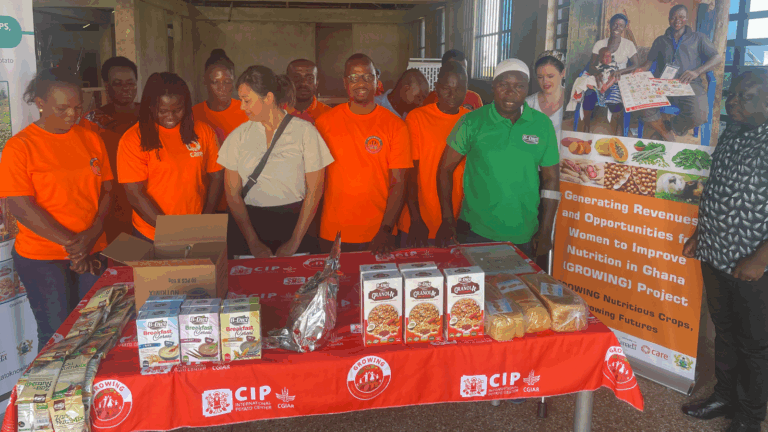
On 30th October, Mrs. Shafiqah Muhamad Nor, Deputy Director for Global Affairs Canada (GAC) based in Ottawa, visited the GROWING Project in Northern Ghana to observe how its integrated agriculture–nutrition–marketing approaches are transforming local markets, creating economic opportunities for women and youth, and improving household diets. During the visit, Mrs. Shafiqah toured B-Diets PLC, an innovative medium-scale agro-processing enterprise that specializes in adding value to locally produced, nutritious, and climate-resilient crops such as orange-fleshed sweetpotato (OFSP). At the facility, she observed the process of converting OFSP into purée and transforming it into a range of marketable products, including biscuits, granola, and Zaa Nutri instant cereals.
According to Mr. Charles Atia, Manager of B-Diets PLC, collaboration with the GROWING Project has enabled the company to expand production of OFSP-based products, improving their nutritional quality while reducing production costs. Since OFSP is a high-yielding and climate-resilient crop, it provides affordable raw material compared to other ingredients, making the enterprise more competitive and sustainable. Mrs. Shafiqah also interacted with Mr. Ganio, a model farmer from the Gushegu District (approximately one hour from Tamale), who produces both OFSP roots and vines using solar-powered irrigation. He supplies his produce to agro-processors and fresh root traders in Tamale, contributing to a growing value chain that links smallholder farmers with emerging urban markets.

B Dite PLC won in the 2025 national Small and Medium Enterprises award with three categories such as: 1) industrial sector award for being economically and socially impactful by creating market and job opportunities for farmers and youth; 2) Product excellence award for being an innovative and using Ghana made and locally produced crops such as OFSP as ingredients; and 3) Leadership award for enabling the PLC to become competitive in the market in a short period of time. With three of his OFSP based products being approved by the Food and Drug Authority, he is currently increasing the volume of production and market outlets.
The Deputy Director also visited the orange-fleshed sweetpotato (OFSP) fresh market at Aboabo, the largest open market in Tamale. There, she met one of the 12 traders trained by the GROWING Project on marketing and business development, who has been linked to Healthy Food Connectors local entrepreneurs using tricycles to transport fresh OFSP roots from remote farming communities to urban markets. It was inspiring to witness how these traders and transporters are turning this climate-resilient and locally adapted crop into income-generating and nutrition-enhancing opportunities, while at the same time preserving local culinary traditions.
These interactions offered the Deputy Director valuable insights into how empowering women and small- and medium-sized enterprises (SMEs) can stimulate change across the entire value chain, from farmers and aggregators to agro-processors, retailers, and consumers, fostering both economic resilience and improved nutrition outcomes.
“This visit demonstrates the profound impact that connecting nutrition, enterprise, and market access can have on communities. Seeing how OFSP is empowering women, supporting farmers, and improving diets in Tamale is both inspiring and a powerful example of sustainable development in action”, said Mrs Shafiqah.
The GROWING Project remains committed to fostering innovation, strengthening SMEs, supporting women entrepreneurs, and linking farmers to markets. By leveraging climate resilient and nutritious crops such as OFSP as both a nutritional and economic asset, the project is supporting vulnerable communities build more resilient livelihoods while addressing critical nutrition gaps.
Article written by Birhanu Biazin Temesgen, Mavis Amedegbe and Martha Awino
Acknowledgement
This activity was made possible through support provided by the Global Affairs Canada (GAC). CIP partnered with CARE International, Ministry of Food and Agriculture (MOFA) and the Ghana Health Services (GHS) for the implementation of the GROWING Project. The opinions expressed in this activity are those of the authors and do not necessarily reflect the views of GAC, CARE International, MOFA and GHS