
The Orange-Fleshed Sweetpotato (OFSP) is making waves as a climate-resilient and nutritious crop that offers a powerful solution to Vitamin A deficiency and support adaptation to climate anomalies in Africa. In Sub-Saharan Africa (SSA), including Ghana, efforts have been made to breed and promote locally adapted varieties of OFSP that are rich in Beta-carotene and early harvesting . Traditionally, sweetpotato is consumed mostly by boiling or frying, often seen as a normal snack for children rather than a staple food in households. Value addition and culinary innovation with OFSP still remain limited. More than 90% of sweetpotato in SSA is consumed boiled or steamed, with less than 10% processed through baking, frying or roasting. How this is opposite to China, the world’s largest sweetpotato producer, where sweetpotato is widely processed into food, starch, and other products for human consumption, and animal feed. In SSA, agro-processing and proper utilization of OFSP for nutritional improvement and economic empowerment is truly underdeveloped, despite its enormous potential. This has restricted the crop’s market demand and utilization, thus further contributing to the lack of increments in the area coverage across Africa.
The Generating Revenues and Opportunities for Women to Improve Nutrition in Ghana (GROWING) Project is an integrated climate-smart, Agriculture-Nutrition-Marketing-Finance and gender transformative intervention that aims to improve the nutritional and financial security of women, youth and young children in six districts; Saboba and Gushegu district in Northern region, east Mamprusi and Chereponi districts in Northeast region, and North Gonja and West Gonja districts in Savannah regions of Ghana. GROWING is funded by Global Affairs Canada and implemented by the International Potato Center (CIP) in partnership with CARE International, Ghana Health Services, and Ministry of Food and Agriculture. The GROWING project has promoted high-yielding and Pro-Vitamin A rich OFSP variety, JanLow, as one of the six climate-resilient and nutritious crops including amaranth, moringa, papaya, ground nuts, soybeans and papaya.
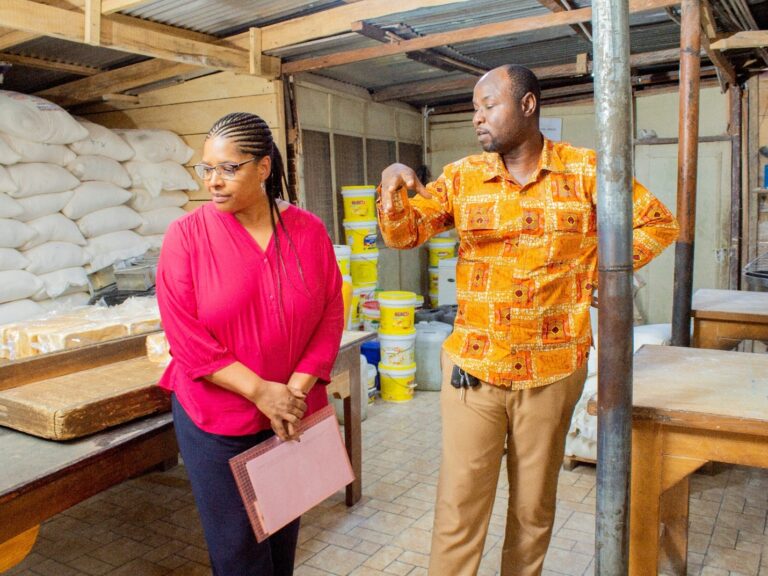
On March 24, 2025, Her Excellency Myriam M., High Commissioner for Canada to Ghana, accompanied by Kathleen Flynn-Dapaah, Director for Development at the High Commission, conducted an official visit to the GROWING project. The purpose of the visit was to observe the tangible outcomes of Canada’s development assistance in advancing nutritional well-being and financial resilience through agro-processing and the commercialization of nutrient-rich crops in Northern Ghana. During the visit, the delegation observed the innovative processing of Orange-Fleshed Sweet Potato (OFSP) puree and its application in the production of value-added, nutrient-dense food products, including Golden Delight bread, cakes, biscuits, and granola. The project employs OFSP puree, sourced from locally cultivated varieties, to substitute 35% to 50% of imported wheat flour in these products. This substitution not only enhances dietary diversity and vitamin A intake among consumers but also contributes to local economic development by creating improved market opportunities for small-scale bakers and agro-processors. The bakery team provided a detailed demonstration of the OFSP puree production process and its integration into bread-making, emphasizing the nutritional benefits and potential scalability of the approach. Additionally, a product exhibition and marketing event was held, featuring a range of OFSP-based food items such as B-diet granola, biscuits, and instant cereals, further illustrating the project’s impact on both public health and local enterprise development.
With the objective of stimulating market demand and increasing the consumption of Orange-Fleshed Sweetpotato (OFSP) in both rural and urban communities, the GROWING Project has actively engaged small-and medium-scale agro-processors. This intervention capitalizes on OFSP’s nutritional and economic potential, beginning with the participatory development and testing of over 11 locally adapted recipes suitable for diverse consumption settings.
A key component of this initiative involved integrating OFSP puree into widely consumed local fried food products, such as Koose and Bofrot. Street food vendors, particularly those operating in district towns and rural villages, were identified as small-scale processors capable of incorporating OFSP puree into their offerings. Notably, Koose, traditionally prepared from cowpea flour—was successfully fortified by replacing 45% of the cowpea flour with OFSP puree. This substitution resulted in enhanced taste, improved nutritional content, and a reduction in production costs, thereby increasing its appeal among both vendors and consumers. Consequently, there has been a notable rise in interest among food vendors in incorporating OFSP into their product lines.
To facilitate and scale up this innovation, the GROWING Project distributed 30 manual OFSP puree-making machines, referred to as “Puree-Pro” to agro-processing clubs established across the six project districts. Constructed from food-grade materials, these machines feature a detachable component system to ensure ease of cleaning and maintenance. Designed specifically for small-scale operations, the Puree-Pro units retain the peel of the OFSP root during processing, thereby enhancing the dietary fiber content and enriching the final product with essential micronutrients such as iron (Fe) and zinc (Zn).
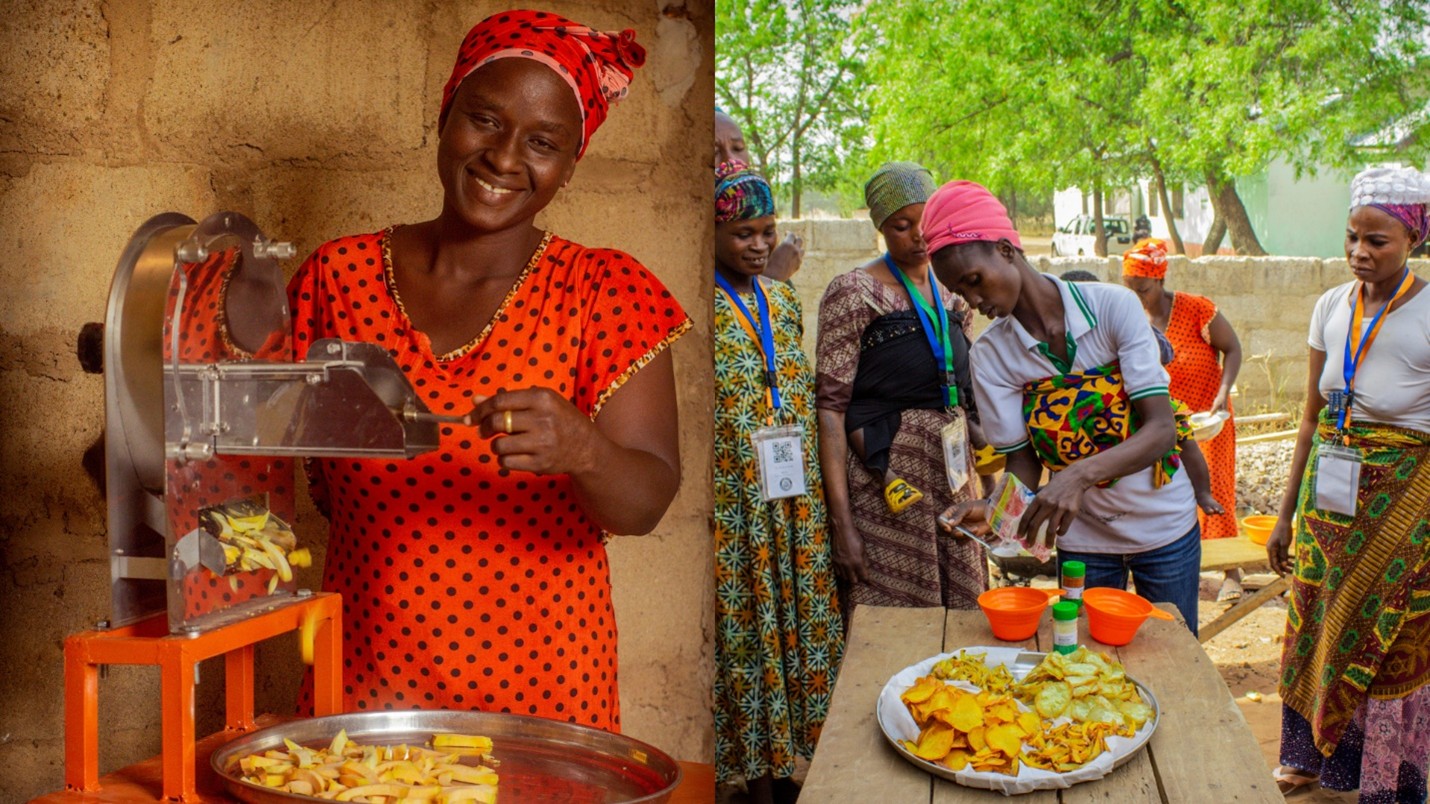
In addition to its community-based interventions, the GROWING Project strategically partnered with two medium-scale food processing enterprises to advance the commercialization of Orange-Fleshed Sweetpotato (OFSP) products in Tamale, the regional capital of Northern Ghana. Through an open call for expressions of interest, the project invited applications for a co-investment opportunity aimed at supporting the commercial processing of OFSP puree for use in bakery products, including bread, biscuits, and granola. Following a competitive selection process, Shekinah Bakery PLC and B-Diet Limited were chosen as implementation partners.
Shekinah Bakery PLC, the largest bakery in Tamale with an established distribution network, was designated as the lead processor for OFSP puree and bread production. With technical support from the GROWING Project, the bakery installed critical equipment, including a root washing machine, steam cooker, puree extractor, and packaging unit. Initial operations commenced with a daily production capacity of 20 kg of OFSP puree, yielding approximately 140 loaves of fortified bread per production cycle. To ensure consistency and scalability, a deep freezer was installed for cold storage of processed puree. Moreover, Shekinah Bakery has been linked with dry-season irrigation farmers who have committed to staggered planting schedules to ensure a continuous supply of fresh OFSP roots throughout the year.
B-Diet Limited, a growing agro-processing enterprise based in Tamale and known for its successful production and marketing of breakfast cereals in local supermarkets, was also engaged by the project. The company received comprehensive technical and business support, including recipe development for OFSP-based products and the formulation of a business plan for commercial production. Through iterative testing and sensory evaluations, B-Diet developed OFSP-based biscuits and granola, substituting up to 50% of wheat flour with OFSP puree. Additional ingredients, such as sorghum, were sourced from local producers, promoting inclusive value chain development.
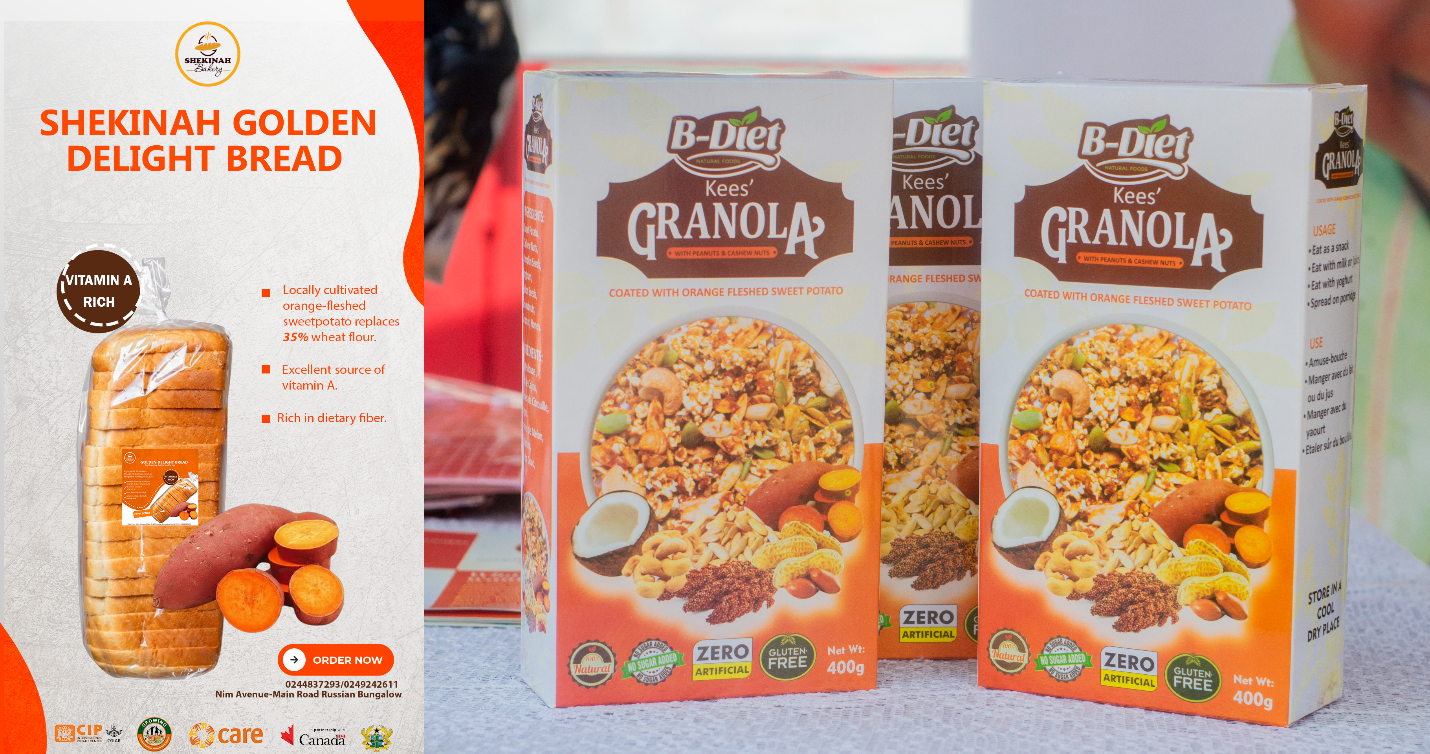
Following regulatory approval from the Ghana Food and Drug Authority (FDA), B-Diet Limited launched the commercial production and marketing of its Orange-Fleshed Sweetpotato (OFSP)-based biscuits and granola. These products have been positively received by consumers, who appreciate their enhanced taste, vibrant natural color, affordability, and nutritional value—particularly their role in improving dietary vitamin A intake. By offering competitively priced, locally produced alternatives to imported food products, B-Diet’s OFSP product line contributes meaningfully to regional nutritional improvement and market diversification.
The innovative integration of OFSP into both baked and fried food products highlights the crop’s transformative potential to improve nutritional outcomes while generating economic opportunities within local value chains. As part of a comprehensive strategy to strengthen small- and medium-scale OFSP agro-processors, the GROWING Project has provided technical training in food processing and safety standards, facilitated partnerships with local equipment manufacturers, and established supply linkages with smallholder OFSP producers operating under both rainfed and irrigated systems. Additionally, targeted demand creation and promotional campaigns have been conducted in both rural and urban settings to boost market uptake.
Through a participatory action research approach, the GROWING Project aims to unlock the significant potential of OFSP as a climate-resilient root crop. The initiative is advancing the development of sustainable, nutrition-sensitive farming systems that enhance both food and income security across Northern Ghana.
Article written by Osman Wiredu, Birhanu Biazin Temesgen and Mavis Amedegbe
Acknowledgement
This activity was made possible through support provided by the Global Affairs Canada (GAC). CIP partnered with CARE International, Ministry of Food and Agriculture (MOFA) and the Ghana Health Services (GHS) for the implementation of the GROWING Project. The opinions expressed in this activity are those of the authors and do not necessarily reflect the views of GAC, CARE International, MOFA and GHS.